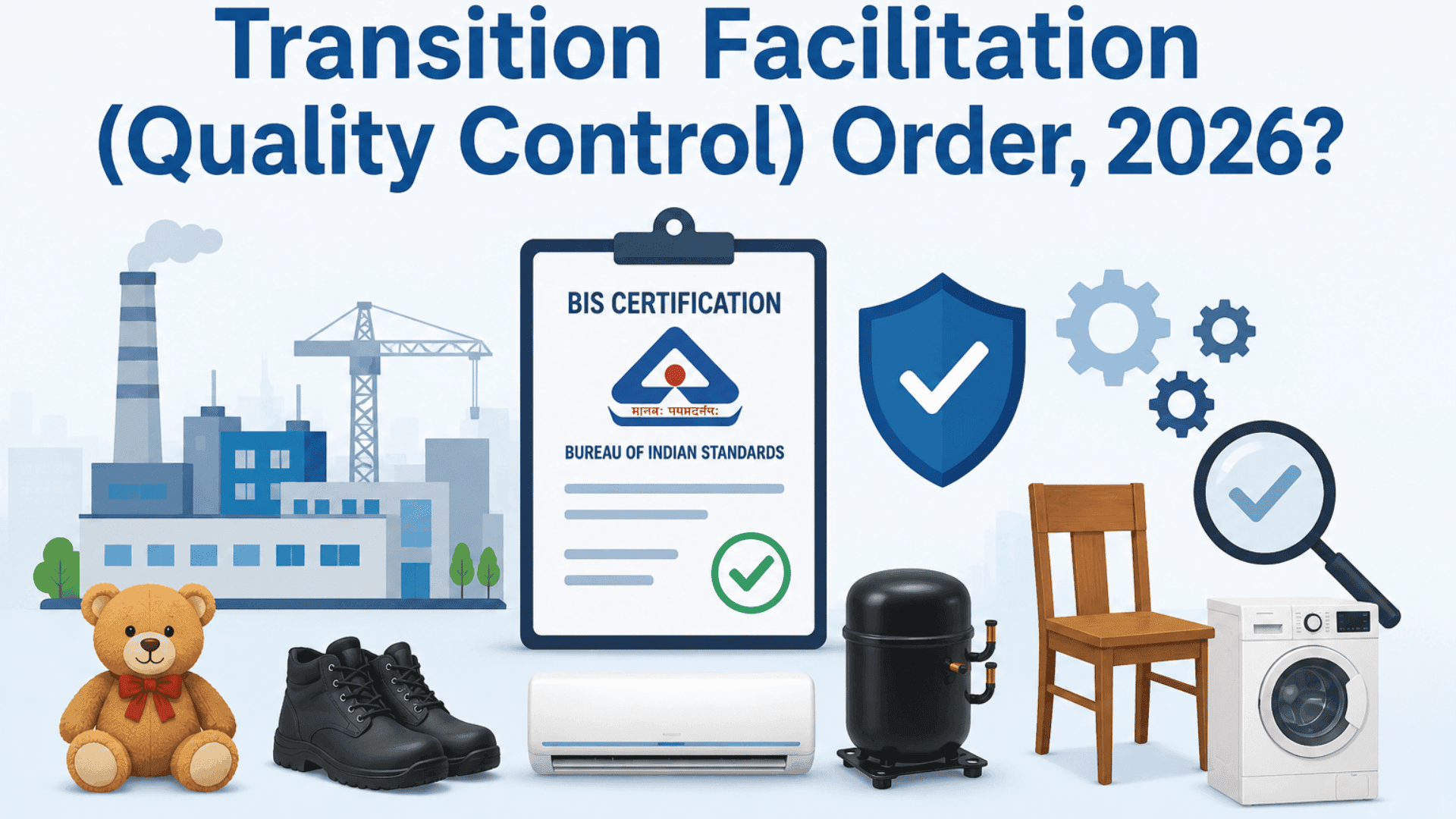
What is the Transition Facilitation (Quality Control) Order, 2026?
The Transition Facilitation (Quality Control) Order, 2026 is a major regulatory initiative introduced by the Department for Promotion of Industry and Internal Trade (DPIIT) under the Ministry of Commerce and Industry. Issued on 25 June 2026, the Order provides an alternative compliance pathway for eligible domestic businesses covered under selected Quality Control Orders (QCOs) while they continue working toward full BIS Certification.
The primary objective of this Order is to reduce compliance challenges faced by manufacturers, importers, and brand owners due to delays in obtaining mandatory BIS licences. It allows eligible businesses to continue operations without compromising product quality and safety.
Why Was the Transition Facilitation Order Introduced?
Over the past few years, India has expanded the number of mandatory Quality Control Orders across multiple industries. While these regulations improve product quality and consumer safety, many businesses have experienced delays in obtaining BIS certification due to inspection schedules, testing requirements, and licensing procedures.
To address these concerns, DPIIT introduced the Transition Facilitation (Quality Control) Order, 2026, creating a temporary compliance mechanism for eligible companies until they receive regular BIS approval.
The Order will remain in force for five years from its commencement unless extended by the Central Government through an Official Gazette notification.
Key Features of the Transition Facilitation (Quality Control) Order, 2026
1. Alternative Compliance Pathway
The Order provides eligible companies with an alternative route to comply with selected Quality Control Orders without waiting for the complete BIS licensing process under Scheme-I.
2. Risk-Based Approval
Applications are evaluated by an Implementation Committee based on several factors, including:
- Technical capability
- Previous compliance record
- Manufacturing quality systems
- Investment in innovation and R&D
- Product design capabilities
- Supply chain reliability
Only companies meeting the required standards are granted approval.
3. Scheme-II Manufacturing
Eligible businesses may source products from manufacturers holding BIS Scheme-II licences, where products are supplied through a self-declaration of conformity to applicable Indian Standards.
This differs from Scheme-I, where factory inspections, surveillance, and an ISI Mark licence are mandatory before products can be sold.
Products Covered Under the Order
The Transition Facilitation framework applies to products covered under ten existing Quality Control Orders, including:
- Toys (Quality Control) Order, 2020
- Personal Protective Equipment (PPE) Footwear
- Air Conditioner and Hermetic Compressors
- Footwear made from Rubber and Polymeric Materials
- Leather Footwear
- Domestic Water Heating Appliances
- Domestic Clothes Washing Machines
- Hinges
- Furniture
- Household Electrical Safety Products
Manufacturers dealing in these regulated products should review the Order carefully to determine their eligibility.
Who Can Apply?
The Order is applicable to domestic companies that:
- Are incorporated under the Companies Act, 2013.
- Meet the eligibility criteria specified by DPIIT.
- Successfully pass the risk assessment conducted by the Implementation Committee.
- Demonstrate strong technical capability and compliance history.
The framework is designed only for eligible businesses and does not provide automatic approval.
Role of the Implementation Committee
To ensure smooth implementation, DPIIT has constituted an Implementation Committee comprising representatives from:
- Bureau of Indian Standards (BIS)
- Department of Commerce
- Department of Consumer Affairs
- Directorate General of Foreign Trade (DGFT)
- Other concerned ministries
The Committee reviews applications, conducts technical evaluations, assesses risks, and recommends approvals under the Transition Facilitation framework.
What Should Businesses Do?
Businesses covered under the selected Quality Control Orders should begin preparations immediately by:
- Confirming whether their products fall under the notified QCOs.
- Checking eligibility requirements under the Companies Act, 2013.
- Preparing technical documents, test reports, and manufacturing records.
- Organising quality certifications and supply chain documentation.
- Monitoring future DPIIT notifications and compliance guidelines.
- Continuing the regular BIS Certification process for long-term compliance.
Proper documentation and timely application can significantly improve the chances of approval.
Importance of BIS Certification
Although the Transition Facilitation Order provides temporary regulatory relief, it does not replace BIS Certification. Businesses are still expected to obtain the appropriate BIS licence to ensure long-term legal compliance and uninterrupted access to the Indian market.
The Order simply offers a transitional framework that allows eligible companies to continue manufacturing and supplying regulated products while completing the certification process.
Conclusion
The Transition Facilitation (Quality Control) Order, 2026 represents an important step toward simplifying India's quality compliance system without compromising product safety. By introducing a risk-based alternative compliance mechanism, DPIIT has provided much-needed support to manufacturers operating under selected Quality Control Orders.
However, businesses should treat this as a temporary facilitation measure rather than a substitute for BIS Certification. Companies should continue preparing for full compliance while taking advantage of the transition framework wherever eligible. Seeking professional regulatory guidance can also help businesses complete documentation, meet eligibility requirements, and achieve faster compliance under the evolving Indian quality control regime.